
Cover Story
Not a fundraising shortcut:
What innovative finance actually asks of your organisation
By Abha Thorat-Shah

For many nonprofit leaders in India, the funding conversation today can feel strangely contradictory. There is more language than ever about innovative finance: blended finance, outcomes-based contracts, impact-linked loans, development impact bonds (DIB) and newer regulated platforms such as the Social Stock Exchange (SSE). But inside organisations, the reality feels more constrained: less flexible money, more compliance, more reporting, and a constant pressure to fundraise without the operating room to build the capabilities that good work requires.
A recent IDR article captured this plainly: 80% of Indian nonprofits have less than 25% flexible funding. Most organisations are trying to deliver complex social change with funding that is restricted, activity-linked and hard to adapt when evidence changes, circumstances shift, or external shocks hit.
Innovative finance should not be treated as a fundraising shortcut. It is better understood as a way of asking a different set of questions: what problem are we trying to solve, what kind of capital does it need, who should take which risk, and what would this structure ask of us?
So when a funder asks whether you have considered blended finance, an impact bond, or an SSE listing, the instinctive response may be curiosity, but also a quiet dread. Are they relevant to us? Or are they just another layer of complexity dressed up as opportunity?
That moment is where this article begins. Innovative finance should not be treated as a fundraising shortcut. It is better understood as a way of asking a different set of questions: what problem are we trying to solve, what kind of capital does it need, who should take which risk, and what would this structure ask of us?
This shift in lens matters as these models begin to widen the funding imagination in India. Used well, they can do more than bring in money. They can help organisations sharpen outcomes, strengthen data systems, build credibility with new funders, and think deliberately about the kind of capital each problem needs. At their best, they do not just finance good work; they help make that work more visible, measurable, and capable of attracting the right capital for the right purpose.
But they ask something of the organisation too.
Some instruments are outcome-based: money is linked to whether agreed results are achieved. Others are debt-based: philanthropic or guarantee capital makes lending less risky or more affordable. Blended finance combines different kinds of capital, so risks and returns are shared differently. The SSE, meanwhile, is less a public-market listing and more a regulated pathway for fundraising, disclosure and visibility, with the promise of becoming more powerful as the ecosystem matures. The point is not to master every label but to understand what each model is asking the organisation to be ready for.
Start with the problem, not the product
The question is not, ‘Should we do a DIB, a blended finance structure or an SSE listing?’ The better question is: ‘What is the financing problem beneath the funding gap?’
If the problem is that an intervention has strong outcomes but needs multi-year funding and flexibility, an outcomes-based structure may be relevant. If the problem is working capital or growth capital, debt may help, but only if the organisation has predictable cash flows and the ability to repay. If the problem is visibility, governance and access to CSR or philanthropic capital, the SSE may be worth exploring.
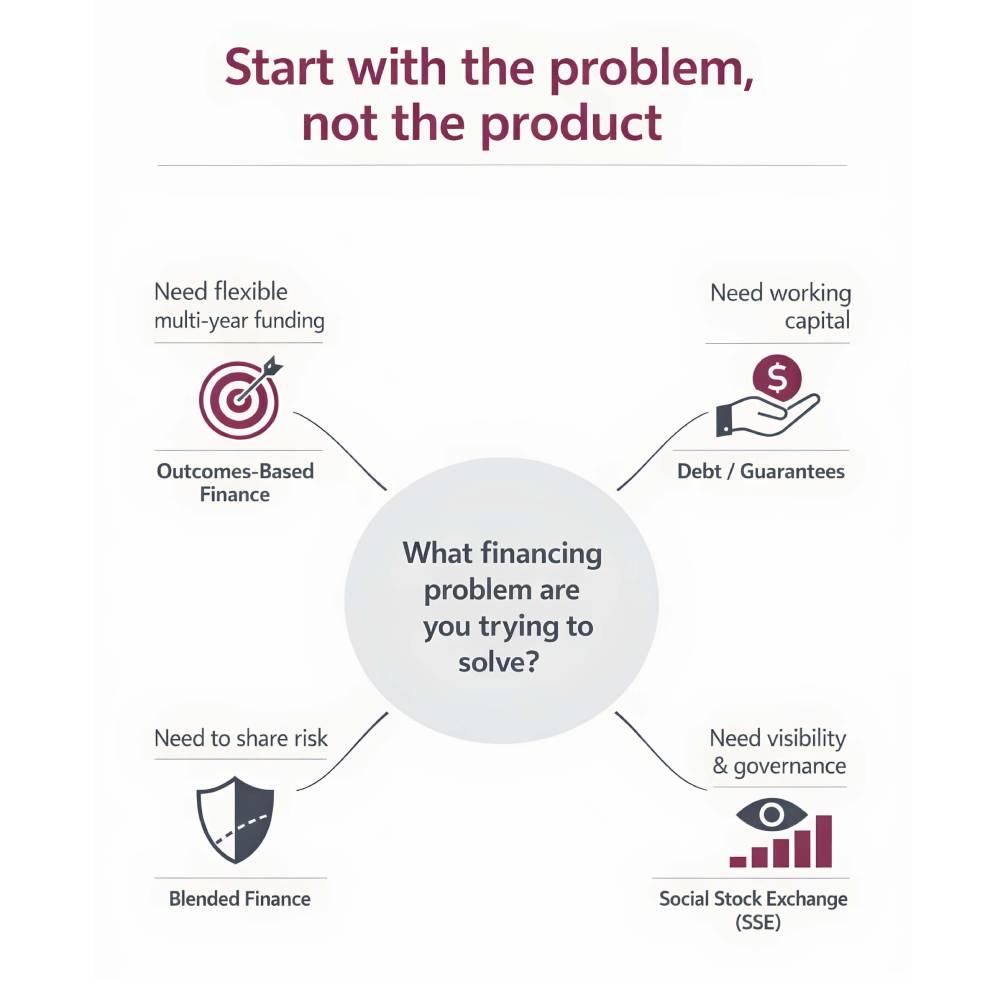
For instance, a skilling organisation may have a strong model and clear employment outcomes, but learners cannot afford the upfront fees needed to expand access. A blended structure could, in theory, combine philanthropic risk capital, bank lending and outcome-linked incentives so that more learners can enrol and the provider can grow. The core question to ask is: does this solve the real barrier to scale, and does it move the organisation closer to something more durable than the next grant?
That is the shift nonprofit leaders need to make using innovative finance, as a lens for matching the right kind of capital to the right kind of problem.
What outcomes-based finance taught me
Outcomes-based finance is where I learned this most directly: the structure of funding shapes everything that follows. I came to it not from a single vantage point but from the space between funders and nonprofits, asking how funding could be structured to work harder for the people it was meant to serve.
What drew me was simple. Done well, outcomes-based finance backed good organisations to achieve real results, gave them time and flexibility to find their own path, and held everyone, including the funder, accountable for what actually changed. But the instrument was only as good as the conditions around it. It worked when nonprofits brought intent, evidence, systems, and culture, and when the ecosystem brought credible measurement, capable intermediation, and patient capital.
At first glance, outcomes-based finance can look like the opposite of flexible funding: structured, conditional and tied to pre-agreed results. But the best outcomes structures create a different kind of freedom. They hold the north star steady while allowing the route to change.
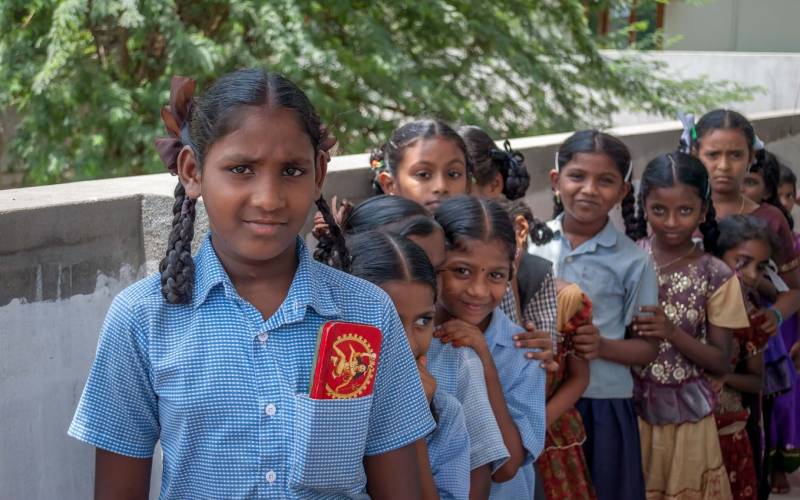
The Educate Girls Development Impact Bond showed this clearly. The outcome was fixed: girls enrolled in school, children learning. When learning gains lagged, Educate Girls changed teaching groups, revised the curriculum, introduced personalised learning and increased home visits, without renegotiating the whole program. By year three, it had achieved 116% of its enrollment target and 160% of its learning target.

The Quality Education India DIB, which I had the privilege of being part of, had to adapt the same principle under COVID-19. When schools closed, the question was not whether the original activity plan could continue exactly as written. The question was whether children were still learning. Partners, all leading education non-profits, adapted through edtech, community classes and home-based support. Funders stayed firm, and critically, learning loss was mitigated.
With the Skill Impact Bond, developed in partnership with the National Skills Development Corporation, we applied the same logic to the skilling ecosystem and its impact on gender outcomes. In addition to training completions, the project measured job placement and retention, forcing delivery partners to focus on the barriers that stop women from entering training and staying in work. By the end, 50,000 young people had been trained, 73% of them women, with placement and retention rates reported at five and six times higher, respectively, than comparable national skilling schemes.
The lesson is not that every organisation should pursue an impact bond, but that the right financing structure, coupled with meaningful outcomes and credible data, can create a powerful combination of flexibility and discipline.
Who should explore these models?
These models are not for every organisation at every stage. Organisations that are early-stage, community-first, or still testing their intervention may need flexible grants, core support and evidence-building before an innovative finance structure. There is no virtue in taking on a complex transaction before the basic conditions are in place.
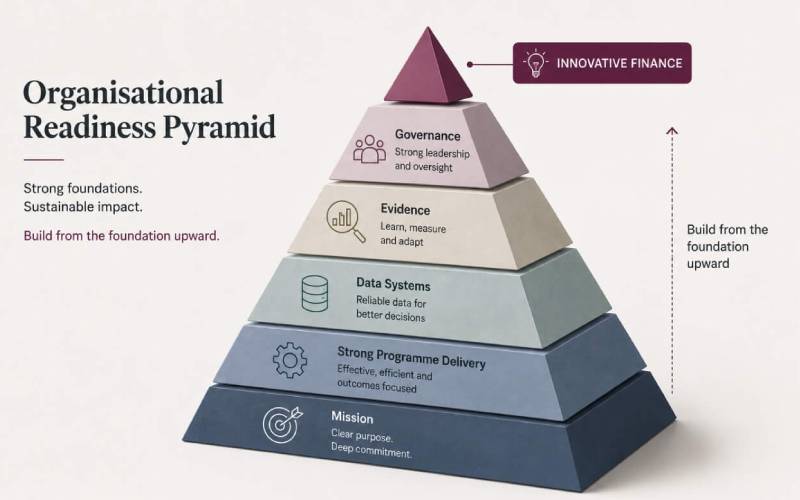
Organisations with clearer outcomes, stronger evidence, deeper systems, and a pathway to scale may be better placed to explore outcomes-based or blended structures.
Organisations with clearer outcomes, stronger evidence, deeper systems, and a pathway to scale may be better placed to explore outcomes-based or blended structures. Organisations with earned income or predictable cash flows may be suited for debt or guarantees. Those looking to strengthen governance, disclosure and visibility with CSR and philanthropic funders may find the SSE relevant.
The point is not whether an organisation is ‘innovative’ enough. The point is whether the financing model fits the organisation’s stage, structure, ambition and risk.
Before any serious conversation with a funder, five questions are worth asking.
- Is our theory of change stable, and are our outcomes meaningful enough to contract around?
Not outputs, but outcomes. Not ‘we trained 500 women’, but ‘we placed 350 women in jobs they held for three months’. If the outcome cannot be defined with confidence, a complex instrument will simply make the ambiguity more visible. - Can we evidence outcomes meaningfully, and who should invest in that capacity?
A DIB needs real-time performance management. The SSE requires impact metrics and governance disclosures. Debt or guarantee-backed structures need credible financial and operating data. This is an organisational readiness question, but also a funder question. Measurement costs money, and someone has to pay for it. - Does our legal structure and financial model permit this instrument in India?
This question is often skipped but often decisive. Section 8 companies cannot receive equity. SSE listings involve registration and compliance. Debt-based and risk-based instruments may require predictable cash flows, debt-servicing capacity, collateral, a credible business plan, or a track record lenders can assess. Legal and tax advice is not a formality, but a part of the feasibility test. - Do we have the capacity to manage this alongside delivery?
The transaction burden is real: performance reporting, investor relationships, legal compliance, independent evaluation and internal data reviews, all alongside program delivery. If the instrument hollows out the team it was meant to strengthen, the timing is wrong. - Have we set our guardrails?
Every financial instrument creates incentives. Before entering any structure, decide what must remain non-negotiable: the populations you exist to serve, the equity principles you will protect, the program choices you will not allow repayment terms to distort, and the outcomes you will not simplify beyond meaning. These guardrails keep the instrument in service of the mission, rather than allowing the mission to bend around the instrument.
What is live in India right now
For organisations that have worked through these questions and still see a fit, the landscape in India is becoming more interesting.
Outcomes-based finance now has evidence across education, skilling and health through the Educate Girls DIB, the Quality Education India DIB, the Skill Impact Bond and the Utkrisht Maternal Health DIB.
The SSE is also evolving. At this stage, it is best understood as a regulated route for fundraising. Its immediate value is in strengthening governance and reporting, and improving access to CSR and philanthropic funders. Over time, it may become a more significant public-facing channel for social capital.
Blended finance is growing where a grant alone cannot suffice: where risk needs to be shared, lending needs to be made affordable, or an organisation needs to bridge towards more durable sources of capital.
Blended finance is growing where a grant alone cannot suffice: where risk needs to be shared, lending needs to be made affordable, or an organisation needs to bridge towards more durable sources of capital. The REVIVE Alliance, a platform led by Samhita that used blended structures to help informal workers and micro-entrepreneurs access affordable credit during COVID, is one example of what this can look like in practice.

So the direction of travel is encouraging, though the market is still evolving. Grants will remain essential, even as new financing models begin to open different possibilities for organisations.
What the ecosystem must now do
The burden cannot sit with nonprofits alone. If innovative finance is to move from specialist practice to wider sector opportunity, the ecosystem has to make it easier to understand, use and adapt.
The burden cannot sit with nonprofits alone. If innovative finance is to move from specialist practice to wider sector opportunity, the ecosystem has to make it easier to understand, use and adapt.
Funders need to pay for readiness: data systems, evaluation, legal support, performance management and the time it takes to structure well. Intermediaries need to reduce complexity through clearer explanations, better templates, shared metrics, lower transaction costs and more honest translation between funder language and nonprofit reality.
Governments and CSR funders need to signal where they are willing to pay for outcomes at scale, so that organisations are not building evidence in a vacuum. Without clearer rules and practical pathways for outcome payments, guarantees, concessional debt, CSR, philanthropy, and commercial capital to work together, too many promising ideas will remain bespoke, expensive, and difficult to use.
The sector also needs to make its own learning more visible. Successful examples, from NSDC’s Skill Impact Bond to SEWA’s Livelihood Recovery and Resilience Fund supported by The Blended Finance Company, should not remain understood only by the small group of people who structured them. The stories, tools, costs, mistakes and adaptations need to be translated for sector leaders and fundraisers in plain language.
Done well, innovative finance can help organisations, funders and governments ask a better question together: not only how money was spent, but what changed because of it, and how capital, in all its forms, can be put to work in service of that change.
Resources
For a funder-facing view of innovative finance
McKinsey, Beyond the Grant: How philanthropy can rewire education financing
For understanding that not all capital is the same
Bridges Fund Management, The Bridges Spectrum of Capital
For an India-specific primer on innovative finance instruments
ISDM, Innovative Finance Made Simple: A primer for innovative financing instruments in India
Convergence – for blended finance
Probably the best-known global platform for blended finance, with primers, data and transaction
For assessing outcomes readiness in Indian nonprofits
ISDM, State of the Sector Report: Outcomes Readiness Among Indian Nonprofits

is Director of Global Engagements at The Convergence Foundation, an Indian philanthropic foundation backing system change across education, skilling, governance, and economic mobility. She was previously Executive Director (Social Finance) at the British Asian Trust, where she was part of the leadership team of the cross-organisation consortium behind the Quality Education India Development Impact Bond; the Skill Impact Bond with NSDC & the LIFTEd DIB1 – three of India’s five impact bonds to date. Abha would like to thank all her friends and colleagues who contributed, edited and challenged her while writing this article- it always takes a village!
Copyright © 2026 India Leaders For Social Sector