
Guest Column
Beyond Funding Projects:
Why Institutional Strength Determines Social Impact at Scale
Archana and Amit Chandra - Co-founders, A.T.E. Chandra Foundation

India’s social sector is at an inflexion point. Big bets, blended finance, the Social Stock Exchange, outcomes-based funding, and philanthropic collaboratives are all expanding what is possible. The appetite for investing more boldly in social change is finally growing.
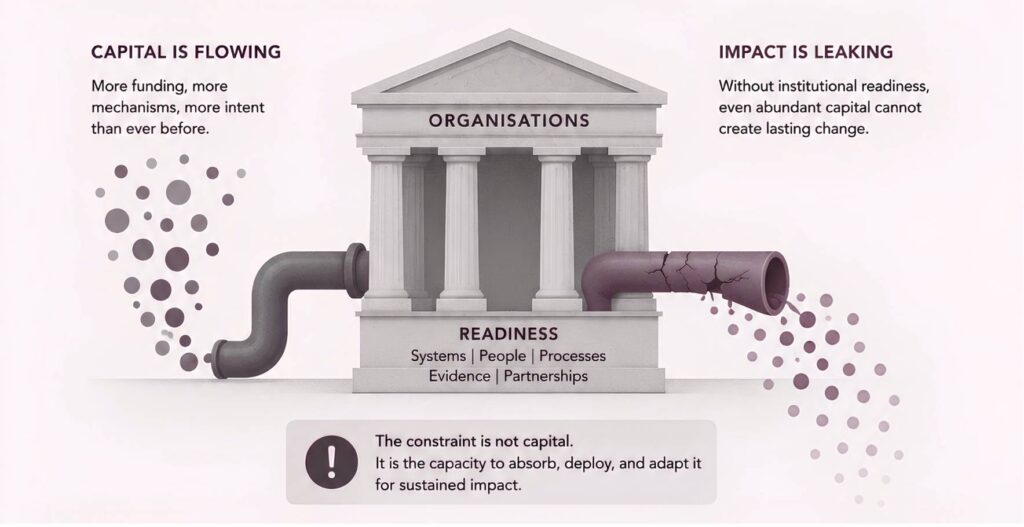
And yet, for most organisations, these new doorways remain firmly shut. Not for want of ambition. Not for want of impact. The gap between emerging capital and social impact is, at its core, a gap of institutional readiness on one side and donor imagination on the other, where organisations are not yet equipped to absorb capital at scale, and funding approaches often remain constrained to short-term, programmatic support rather than investing in the institutional capabilities that enable sustained impact.
This matters because India is witnessing the emergence of financing mechanisms that some thought leaders have sought for decades. Yet there is a risk that the very organisations capable of driving social change remain excluded, not because they lack competence, but because they lack institutional infrastructure that these mechanisms require. If we do not address this gap now, we risk creating a future where capital exists, but too few organisations are equipped to absorb it effectively.
The New Capital Landscape Is Real and Demanding
Consider what it took for Educate Girls to participate in India’s first education Development Impact Bond. Before a single rupee could flow, the organisation needed a performance management culture, robust monitoring and evaluation systems, and the credibility to withstand independent assessment against pre-agreed outcomes. The DIB did not build these capabilities; it required them. Since Educate Girls had invested in institutional strength, it went on to exceed both enrolment and learning targets, demonstrating what outcomes-based capital can achieve in the right hands.
This is not an isolated example. Whether it is blended finance, outcomes contracts, collaborative funds, or the Social Stock Exchange, the common requirement is the same: governance rigour, financial transparency, credible evidence systems, and accountability to multiple stakeholders.
These are not compliance requirements. They are signals of a deeper shift. Organisations that invest in these capabilities will find new opportunities opening. Those who do not will discover that the sophistication of the financing instrument changes very little when internal readiness is missing.
The Real Constraint Is Not Capital - It Is Readiness
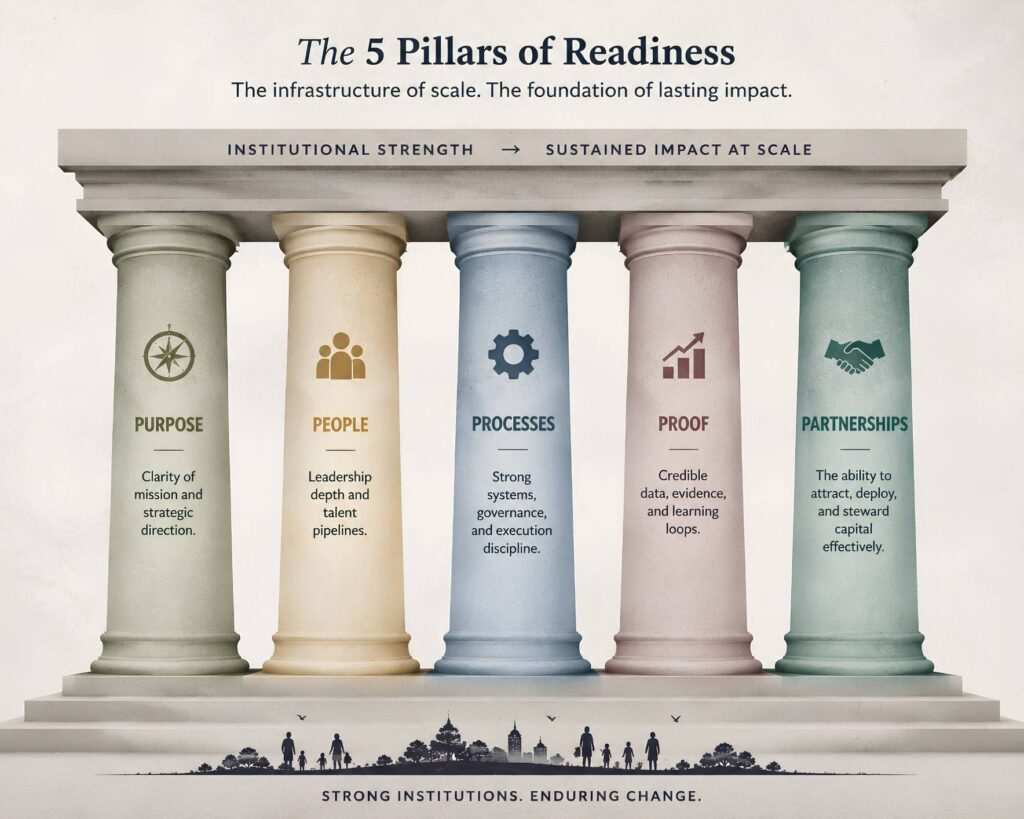
The primary barrier to impact in India’s social sector is not the availability of capital; it is the capacity of institutions to use it imaginatively and freely. Our work at the A.T.E. Chandra Foundation, together with a study conducted by Pramiti Philanthropy Partners and Impact Sherpas across 18 nonprofit organisations, points to a consistent conclusion: when institutions invest in their own capabilities, impact scales disproportionately.
The findings converge into what we call the 5 Pillars of Readiness:
Purpose: Clarity of mission and strategic direction.
People: Leadership depth and talent pipelines.
Processes: Strong systems, governance, and execution discipline.
Proof: Credible data, evidence, and learning loops.
Partnerships: The ability to attract, deploy, and steward capital effectively.
These are not administrative layers. They are the infrastructure of scale.
Yet much of the sector remains trapped in a cycle of short-term, project-restricted funding. When every rupee is tied to a deliverable, organisations spend their energy surviving the next grant cycle rather than building the capabilities required to access larger opportunities and create lasting impact.
What Readiness Actually Looks Like
Consider the Antarang Foundation. Its inflexion point did not come from launching a new program. It came from investing deliberately in institutional capacity by strengthening leadership through a co‑leadership model that shifted the organisation from founder-driven execution to distributed strategic leadership, building evidence systems, and developing strategic partnerships. The result was a shift from direct service delivery to systems influence, dramatically expanding both reach and depth of impact. This pattern was repeated across all 18 organisations in our study.
Those that invested in institutional capacity consistently outperformed their peers, not just on organisational metrics but also in the speed and scale of social impact.
Those that invested in institutional capacity consistently outperformed their peers, not just on organisational metrics but also in the speed and scale of social impact. In several cases, impact grew five to eight times faster than budget growth, driven by stronger internal systems and the ability to scale through partnerships rather than direct delivery alone.
Program quality matters enormously. But program quality alone cannot explain this differential. Institutional strength does. Strong institutions do more than attract capital. They deliver better outcomes for the communities they serve, adapt more effectively to changing conditions, and sustain impact long after individual projects end.
The Donor’s Role: From Project Funder to Institution Builder
If institutional readiness is the gateway to the next generation of capital, the question for funders is straightforward: What are we doing to help organisations get through it? Capacity-building support requires a different mindset, a different measurement framework, and a longer time horizon than traditional project funding. It cannot be evaluated solely through annual outputs or short-term deliverables.
The evidence from our research is clear. Flexible, multi-year institution-building support was the most consistent differentiator across the organisations we studied. Those that received it outperformed peers in both reach and durability, not because they had more money, but because they had the freedom to build.
In business, no investor would expect an organisation to scale without investing in leadership, systems, technology, governance, and talent.
In business, no investor would expect an organisation to scale without investing in leadership, systems, technology, governance, and talent. Yet in philanthropy, we often celebrate scale while hesitating to fund those capabilities precisely. The result is predictable. We ask organisations to solve increasingly complex problems while withholding many of the tools required to build resilient institutions. This is not simply an argument for unrestricted grants. It is an argument for a broader shift in perspective: from funding projects to investing in organisations.
The highest-leverage investment a funder can make is not necessarily in the most innovative program. It is in the institution capable of delivering, scaling, and sustaining impact over time.
Expanding Our Imagination About Capital
The conversation around new financing models is an important one, and we welcome it. Big bets, blended finance, outcomes contracts, the Social Stock Exchange, and philanthropic collaboratives all have genuine potential to transform how capital flows to the social sector.
But the future of India’s social sector is not just about designing sophisticated mechanisms. It is about building organisations capable of using them. For nonprofit leaders, that means treating institutional investment not as overhead, but as a strategic priority. For funders, it means looking beyond the novelty of new capital instruments and investing in the readiness of organisations to deploy them effectively.
Institutional investment is not separate from the funding conversation. It is the foundation on which every other opportunity rests. The capital is coming. The question is whether we will build institutions capable of turning that capital into lasting change.


Archana Chandra and Amit Chandra are Co-founders of the A.T.E. Chandra Foundation (ATECF), which works to strengthen organisational capacity in India’s social sector. This article draws on findings from an upcoming Pramiti Philanthropy Partners and Impact Sherpas study commissioned by ATECF, examining institutional capacity building journeys across 18 nonprofit organisations.
Copyright © 2026 India Leaders For Social Sector