
FCRA Amendment Rules, 2026
What Nonprofits Need to Do
Shanthi Lakshmanan - Chief Financial Officer, The Convergence Foundation

In Brief
- Review FCRA registration details: Organisations must map their activities to specific purposes and States/UTs, with existing registrants required to file Form FC-6F by 21 June 2027.
- Watch the new compliance thresholds: Renewal now requires at least ₹10 lakh of foreign contribution to have been utilised over the preceding two financial years.
- Strengthen disclosures: Annual returns will require more detailed reporting on projects, locations, social media, ultimate donors and publications.
- Review internal processes: Organisations should update governance records, publication and social-media protocols, donor information, auditor requirements and compliance calendars.
Key changes are as follows:
1. The term ‘key functionary’ is now broader: it covers directors, partners, trustees, ‘Kartas’ of Hindu undivided families, office bearers, governing/management committee members, and anyone else exercising control over the organisation. Foreign nationals not of Indian origin will ordinarily not be eligible to hold this role unless specifically approved by the competent authority. Organisations should review their governing body and authorised signatories against this wider definition.
2. State/UT-specific registration FCRA applications must now specify the purpose from five broad heads — social, economic, educational, cultural, religious — each with its own list of permissible sub-activities in the Schedule, as well as the States/UTs where the contribution will be utilised. A general label like ‘social’ or ‘educational’ is no longer sufficient on its own.
- Existing registrants must file Form FC-6F within one year of notification, by 21 June 2027, specifying the purposes and States/UTs they want to retain.
- Any later change to purpose or location needs prior permission and a governing body resolution.
- The base registration fee of ₹10,000 covers one purpose and one State/UT; each additional purpose or State/UT costs an extra ₹300.
3. An association is deemed to have undertaken ‘reasonable activity’ required for renewal only if it has utilised at least ₹10 lakh of foreign contribution over the preceding two financial years for the stated purpose. Organisations with low or no utilisation should review their renewal position early.
4. Where funds are released in instalments under prior permission, the second and subsequent instalments are released only after 75% of the previous instalment has been utilised and verified through field inquiry.
5. The annual return now requires:
- A detailed, project-wise activity report mapping each project/location to amounts spent (project spend, new assets, admin costs).
- Disclosure of the organisation’s website and social media handles.
- The name of the ultimate donor where funds are routed through Donor Advised Funds or other intermediary vehicles.
- Details of publications, podcasts, or other mass-communication material issued by the organisation or any key functionary — date, nature, title, platform, link, and brief description — alongside a reiteration of the Section 3(1)(g) bar on producing or broadcasting news/current-affairs content.
6. Auditor certification, including for the separate FCRA-specific financials, must now carry a Unique Document Identification Number (UDIN).
Here’s a checklist for immediate action:
- Map every current and planned project to a purpose sub-category and State/UT.
- Review the governing body and management structure against the expanded key-functionary definition, flagging any non-PIO (Person of Indian Origin) foreign nationals in control positions.
- Check foreign contribution utilisation for the last two financial years against the ₹10 lakh threshold.
- Maintain a register of publications/podcasts by the organisation and all key functionaries, including content created in personal capacity.
- Contact donors that route funds through DAFs or intermediaries to obtain ultimate-donor details.
- Brief auditors on the new UDIN requirement.
- Prepare governing-body approvals and documentation ahead of the Form FC-6F filing.
- Maintain a compliance calendar tracking the 21 June 2027 deadline and ongoing annual return obligations.
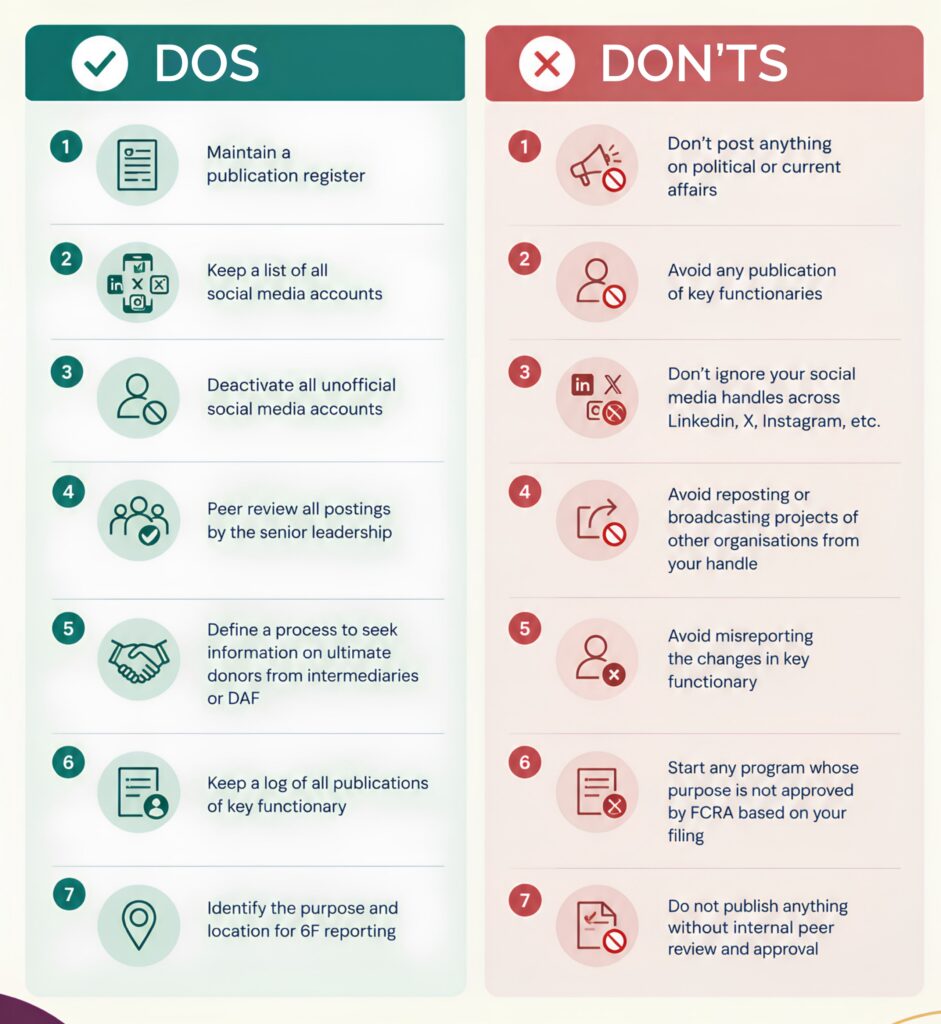
Important note: Don’t confuse this with the pending Bill
A separate Foreign Contribution (Regulation) Amendment Bill, 2026, introduced in the Lok Sabha on 25 March 2026, deals with vesting and disposal of assets when an FCRA certificate is cancelled, surrendered, or lapses without renewal. That Bill is still under consideration in Parliament and is not yet operational. Rules above, however, are currently in force.
This note is for internal awareness and planning. Verify final filing requirements against the official Gazette notification, prescribed forms, and your FCRA consultant or legal adviser before submission.

Shanthi Lakshmanan is a results-oriented leader with over three decades of experience in finance, operations, compliance, and social impact. Transitioning to the social sector a decade ago, she founded ExempServ, which supports boards, trustees, and leadership teams in this sector with financial reporting, compliance, and allied services to enhance their effectiveness and impact.
Copyright © 2026 India Leaders For Social Sector