
Guest Column
The Board Chair in a Social Purpose Organisation
Srivatsan Rajan - Advisory Partner, Bain & Company; Board Chair, ILSS

In Brief
- Anchor the organisation: The chair safeguards the mission, values and long-term interests of the organisation.
- Build an effective board: The chair shapes board composition, encourages diverse perspectives and ensures all voices are heard.
- Be a trusted partner to the CEO: The role requires balancing support, perspective and independent challenge while maintaining clear boundaries.
- Build trust, balance rigour and rapport: A strong Chair-CEO relationship enables candid conversations, better decisions and sustained leadership.
At the centre of an effective board is the board chair: championing the organisation, its leader and the management team, while serving as a vital bridge between the board and the executive leadership.
Governance is steadily finding its place at the heart of India’s nonprofit conversation. Yet, of the country’s roughly 5.15 lakh registered nonprofits, only a small fraction have boards with the structure, discipline and engagement needed to truly add value. As nonprofits grow and evolve, strong boards, whether legal or advisory, the latter at times operating with fiduciary-like responsibilities, are critical for oversight, navigating change, staying anchored to mission and building for the long term. At the centre of an effective board is the board chair: championing the organisation, its leader and the management team, while serving as a vital bridge between the board and the executive leadership.
The Chair's Role: A Perspective
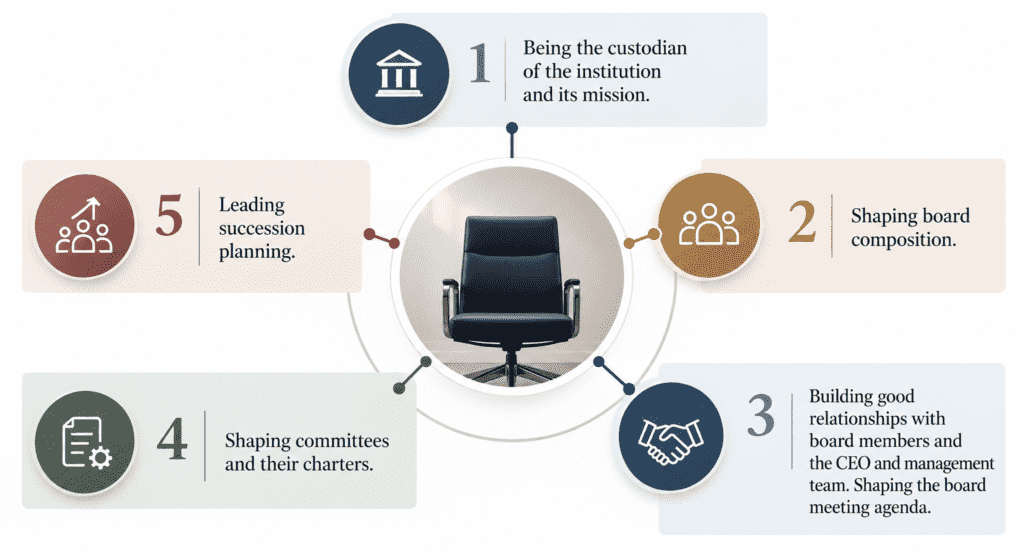
The formal job description of a board chair does not always do justice to what the role demands in everyday practice. At its heart, the chair’s real task is to make two relationships work well: the one with the board, and the one with the founder/CEO/management team. Most of the strength a board has to offer flows from these relationships being healthy, which is why a chair’s authority is almost entirely relational and procedural, and not positional.
The responsibilities span several distinct, equally important areas.
Being the custodian of the institution and its mission.
The chair holds the organisation’s long-term interests above those of any individual, including the founder, who is often the key contributor to its success. It falls on the chair to ensure that the organisation remains true to its purpose, values and stakeholders, especially when there are forces pulling in opposite directions.
Shaping board composition.
What matters most in the long run is who sits around the table, so a good chair takes an active interest in skills, diversity, and perspectives, ensuring the quiet ones find voice, rather than leaving this to chance. This goes a long way in building a strong board culture.
Building good relationships with board members and the CEO and management team.
Knowing each board member well enough to understand what they bring, and knowing the CEO and the management team well enough to be a genuine sounding board rather than a distant overseer is an essential role of the chair.
Conduit for board feedback to the CEO and harmoniser balancing support with independent challenge.
A key role is to create the environment for the board, CEO and founder to work effectively by bringing different perspectives together, asking uncomfortable questions when needed, and acting as a bridge between the Board and executive leadership, ensuring a healthy balance without any overreach by board members.
Shaping the board meeting agenda.
What receives time and what is flagged as urgent shape where the board’s attention goes, and what it can meaningfully oversee. The chair plays the role of keeping the focus on the most important aspects.
Shaping committees and their charters.
Committees carry much of the board’s real work, and the right people, with clear charters, keep that work rigorous, and the Chair plays an important role in shaping these committees.
Supporting fundraising.
The chair supports fundraising where that is part of the role, by opening doors, lending credibility, and at times making the ask directly. The chair, together with the board, can prove to be a big support to the founder.
Leading succession planning.
Whether planned or unplanned, succession is among the board’s most consequential processes, and it typically falls to the chair to lead and facilitate the process when the time comes.
Chair-CEO Relationship
The chair has a very unique relationship with the CEO, acting as the friend, philosopher, guide, critic and bellwether to the CEO.
Strategic partner and sounding board to the CEO.
The chair’s role is, above all, to be present, to listen, provide perspective and help the CEO think through what matters. The chair should be the CEO’s trusted sounding board in both good times and difficult ones, including protecting the founder from mission drift and burnout. As the primary point of contact between board meetings, the chair creates space for regular, informal check-ins and candid conversations. The chair also works with the CEO, management team and the board to build alignment around strategy.
Involvement with people practices and health audit.
The chair’s specific formal duties toward the CEO include leading the hiring process, the annual performance evaluation, setting compensation (via committee), and the hardest one – leading a CEO transition when it occurs.
Guiding the CEO to navigate the board’s feedback.
The chair acts as a buffer between the board and the CEO, protecting the CEO from a diffused or noisy board (filtering, translating, buffering) while still ensuring the board gets what it’s entitled to know, and also distils the board’s critical view of the leadership into something constructive and actionable.
Trust is the Foundation of a CEO-Chair Relationship
Woven through all of this is a single thread: trust. A transparent relationship between the founder/CEO and the chair allows opportunities and challenges to be seen clearly and early.
In the recent past, the COVID-19 pandemic put to test many organisations that were shaken to their core and created significant upheaval that could be felt across the ranks. Where the chair and CEO shared a trust-based relationship, issues surfaced early and the right expertise arrived at the outset, allowing organisations to respond with agility. Such trust also gives the founder/CEO confidence to take considered risks, and to lead with energy and conviction.
Ways to Strengthen the CEO - Board Relationship
A board’s role is to set strategy, ensure financial and risk oversight, appoint and evaluate the CEO, and hold management accountable, without stepping into operational decisions. This distinction matters especially in founder-led organisations, where the founder may historically have done everything, and where governance needs to grow as the organisation does.
Yet, a good board also needs to understand the work of the organisation well enough to shape the management thinking. One practice worth adopting is holding a board meeting in the field, which gives board members a far deeper understanding of the work and often leads to sharper questions, without crossing into management’s territory.
What to watch out for
One aspect to be mindful of is the mechanisms to address any disagreement between the chair and the CEO. Challenging situations may test the fabric of the Chair-CEO relationship and may reveal cracks in the relationship. In crisis moments (financial, reputational, leadership), the chair-board-CEO triangle either holds or collapses under pressure. When the chair-CEO relationship is not working, it may be incumbent for other members of the board to step in and find a resolution.
What This Means for the Social Sector
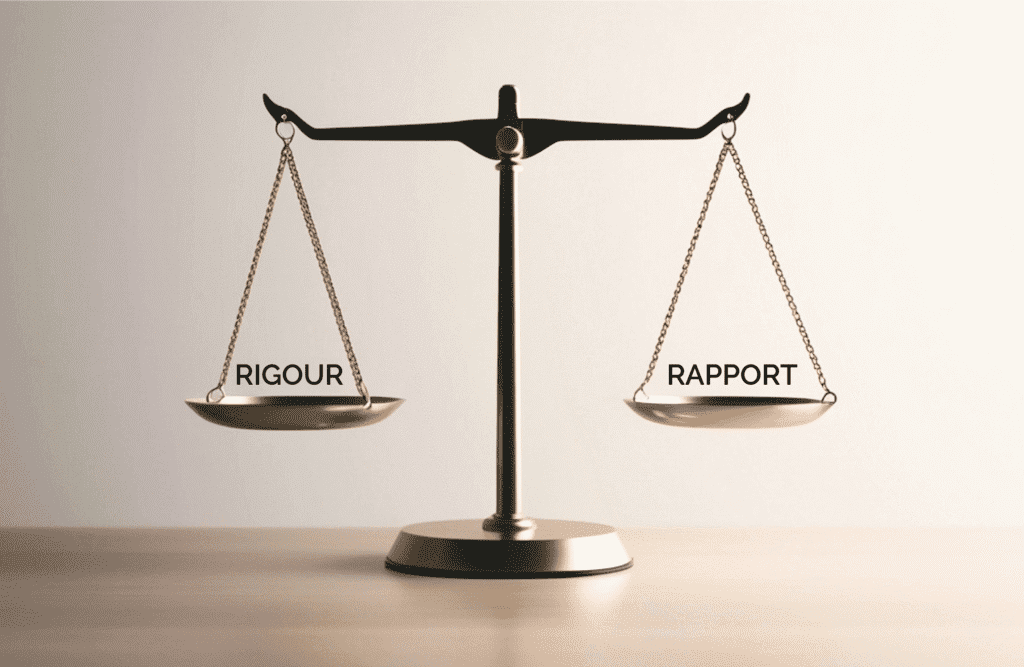
Taken together, these responsibilities point to something larger than any single duty on the list. A good board chair helps a nonprofit hold two things in balance that are otherwise easy to lose: rigour and rapport. Rigour, because a well-composed board, disciplined committees, and a thoughtfully set agenda give an organisation the structure it needs to grow responsibly and account for its work. Rapport, because a chair who works toward the CEO becoming more effective, cares about the founder’s wellbeing, and is focused on the mission gives the organisation the foundation on which that structure can rest.
For a sector built around vulnerable communities and stretched resources, this combination matters enormously. It is what allows an organisation to keep sight of the people it exists to serve, even amid financial, reputational, or operational pressures. And it is what allows a founder to lead with sustained energy and clarity of purpose, rather than carrying that vision alone for years on end.
As more of India’s nonprofits invest in this role and think through it with the same seriousness given to a CEO or a founder, the sector as a whole stands to benefit. A well-supported board chair is not simply good governance. It is a genuine act of stewardship, on behalf of the mission, the leadership, and, ultimately, the communities the organisation was created to serve.
This article is as much a reflection of my own learnings as it is of the insights and experiences generously shared by those I reached out to – Rukmini Banerji, former CEO and Board Member, Pratham; Shridhar Venkat, CEO, Akshaya Patra; Ujwal Thakar, Board Chair, Educate Girls; Nikunj Jhaveri, Board Chair, Access Life Foundation; and Deepak Kapoor, former Board Chair, Save the Children. I am deeply grateful to each of them for sharing their perspectives and enriching this article.

Srivatsan (Sri) Rajan is currently an Advisory Partner at Bain & Company in San Francisco and is the former Chairman of Bain & Company in India. Sri is an investor in and adviser to many startups and funds. He is the Chair of Akshaya Patra, USA, and also serves on the Advisory Board of The Convergence Foundation. He is the Chair of the Advisory Board of ILSS, the GATI Foundation and The Udaiti Foundation.
Copyright © 2026 India Leaders For Social Sector