
Guest Column
Building Together:
For Women and Girls to Lead
Tanya Dikshit, Team Lead, Dasra (Writing for WomenLead India Alliance)
Reflections from the WomenLead India Alliance roundtable at Dasra Philanthropy Week on what it takes to shift systems, strengthen collaboration, and create the conditions for women’s leadership to thrive.
WomenLead India Alliance is a growing platform of organisations spanning the social sector, philanthropy and business, uniting to advance leadership for women and girls. The Alliance works to champion potential, mobilise commitments and build a community where we can collectively work toward a more inclusive world. Now 35 partners strong, the Alliance’s belief is: if we build a meaningful, trusted space that bridges silos and creates the right enabling environment, we can accelerate progress toward more women in leadership across sectors and ensure girls have the conditions they need to unlock their potential. Together, we shape narratives, inspire action and build the philanthropic and institutional commitment that the women’s and girls’ agenda deserves.
This work is taking place at a critical moment for India. Over the past decade, the country has made undeniable progress. Poverty has declined, life expectancy has increased, and India now stands among the world’s largest economies. While women’s empowerment and women-led development have gained visibility in the impact sector and public discourse, structural inequalities remain deeply entrenched. In India, women’s labour force participation stands at just 32.4% compared to 77.6% for men, and over 80% of working women are concentrated in the informal economy, often in vulnerable and low-paying roles. Women also earn approximately 25% less than their male counterparts. These economic disparities are shaped early in life. 23% of women aged 20 to 24 were married before the age of 18, and 14 out of every 1,000 girls aged 15 to 19 gave birth as recently as 2023.
Across sectors, women’s representation in leadership remains limited, at 22% in professional services and entertainment, 23% in administrative services and healthcare, 25% in consumer services, and 29% in government administration, with education seeing the highest at only 30%.
These systemic barriers extend into leadership and decision-making spaces. Across sectors, women’s representation in leadership remains limited, at 22% in professional services and entertainment, 23% in administrative services and healthcare, 25% in consumer services, and 29% in government administration, with education seeing the highest at only 30%. Even within the social impact ecosystem, only 19% of social purpose organisations are led by women.
In this context, advancing women’s and girls’ leadership is therefore not just a sectoral priority. It is a national imperative.
Insights from the recent WomenLead India Alliance Roundtable
The key question on the table was: what is that sticky, shared problem the Alliance can collectively prioritise and move on together?
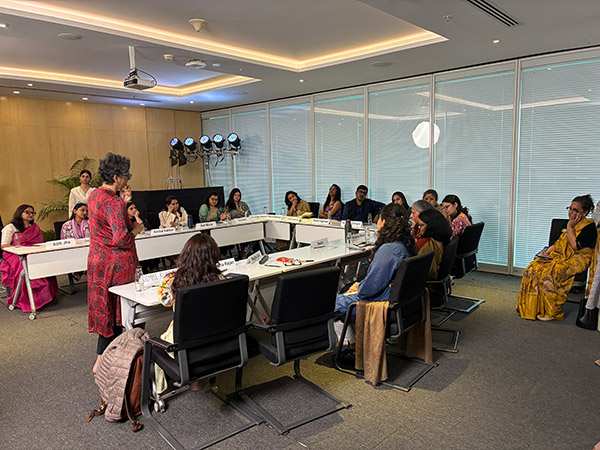
The roundtable was designed as an honest peer learning space. It created room for partners to reflect on progress, surface challenges, and collectively shape the direction of the work ahead.
The conversation started by spotlighting the wins that partners experienced in 2025. In globally stressful times, this felt like an important place to celebrate each other for continuing to push forward. Participants spoke about having access to dedicated spaces for peer learning that have been helpful in connecting with like-minded organisations. They reflected on seeing their organisations’ capacity building efforts actually translate into action: women navigating their imposter syndrome with more support and confidence, women farmers claiming their space and identity.
There was also a deeper rethinking of what leadership means. The definition is expanding beyond titles and seniority to include more voices from the community. Across these examples, a common thread emerged that leadership is not only about formal positions or authority. It is about voice, agency, and the ability to influence decisions. This can happen in a village collective, a nonprofit organisation, or a corporate boardroom.
Importantly, convenings themselves are emerging as catalysts for collaboration. For example, the annual India Women’s Leadership Conference convened by ILSS was cited as a bright moment for learning and partnership across organisations working on gender and leadership.
The challenges we're still pushing against
The group was honest about what’s holding the work back. The conversation moved beyond individual organisational struggles to focus on the shared structural realities that everyone in the room is navigating. Collective action in such scenarios becomes indispensable because these challenges aren’t ones any single organisation can resolve alone.
Funding remains the elephant in the room. The bulk of resources for gender work still comes from foreign institutions, while domestic philanthropy and corporate giving stay on the sidelines. It’s not just about the quantum of funding but also about its nature. Gender norm change is a slow process and yet funding structures keep asking for proof of impact on timelines that don’t match how social change actually happens. Organisations are stretched, having to justify the long game in short-term language.
These constraints reinforce the importance of sustained, flexible funding that recognises the long-term nature of gender norm change and supports leadership development as a systems priority rather than a short-term project.
The collaboration paradox was another thread that ran through the conversation. Goodwill exists in abundance, but when proposals go out and credit is being counted, organisations tend to fall back on doing it alone. With multiple alliances and networks operating in the same space, each with different identities and objectives, the question of how to build real synergy rather than just co-exist becomes pressing. The structures and incentives around funding make genuine collaboration harder.
At the same time, partners recognised that meaningful collaboration requires time, trust, and shared accountability. Building these conditions is itself an important part of the work.
Most fundamentally, the sector is still putting too much on women’s shoulders. The dominant conversation around women’s leadership leans heavily on what individual women need to do differently: lean in more, build more resilience, navigate better. What gets far less airtime is the harder question: what do institutions, workplaces and funding systems need to change so that women’s leadership isn’t an exception requiring extraordinary effort but the norm?
Naming these systemic barriers collectively is an important step toward shifting responsibility from individual women to the institutions and systems that shape their opportunities.
The next frontier: Building narratives that move systems
Narrative building emerged as the strongest collective priority from the discussion. When funding is fragile and the case for gender work still needs to be made to philanthropists, evidence alone is not enough. What shifts things is when the knowledge and learnings that organisations have built over years and the real impact that work has created are brought together as compelling stories: of women navigating systems, of organisations learning and adapting, of leadership being redefined in places it wasn’t expected. Making that impact visible is ultimately what moves the ecosystem from awareness to sustained commitment to giving more and giving better to women and girls.
For the Alliance, narrative building is a strategic lever for change. It shapes how funders invest, how institutions prioritise gender equity, and how society understands women’s leadership.
What comes next: A collective call to action
As a first step in this narrative building work, the Alliance is launching a campaign that puts nonprofits and community organisations front and centre, showcasing their journeys and their impact. It will also bring in the voices of funders who are actively shaping and championing giving to women and girls.
This effort is not just about visibility. It is about strengthening collective understanding of what enables women and girls to lead. It is also about making the work of organisations across the country more visible to those who shape policy, funding, and public discourse.

A shared responsibility for the future
Investing in women and girls is one of the most consequential choices philanthropy and business can make right now for Viksit Bharat@2047. If India is to realise its aspirations for inclusive growth and social progress, women must be present at decision-making tables. They must be shaping institutions, influencing communities, and contributing to the country’s development journey.
That future will not be built by any single organisation acting alone. It will be built through sustained commitment, shared learning, and collective leadership across sectors.
The roundtable conversation was one step in that direction. The work ahead will depend on how we continue to build together for women and girls to lead.
Acknowledgements:
Thank you to Anuradha Rajan (SAWF IN) and Megha Jain (Dasra) for facilitating the conversation and bringing together these insights, and to the Alliance partners who actively shared their perspectives and participated throughout.

Tanya Dikshit is currently with Dasra, where she works on initiatives focused on strengthening women’s leadership and increasing support for gender equity. She brings over seven years of experience across grant management, CSR, and impact advisory, with a strong focus on gender.

The WomenLead India Alliance is a multi-stakeholder partnership that promotes women and girls’ leadership as the pathway to achieving gender equity in India.
The alliance brings together nonprofit, academic, philanthropic and private organisations, underscoring that collaboration is key to creating momentum to achieve gender equity.
Copyright © 2026 India Leaders For Social Sector