
Guest Column
Leading with the Constitution:
A Guide for India’s Social Sector
Vinita Gursahani Singh, Managing Trustee, We The People Abhiyan
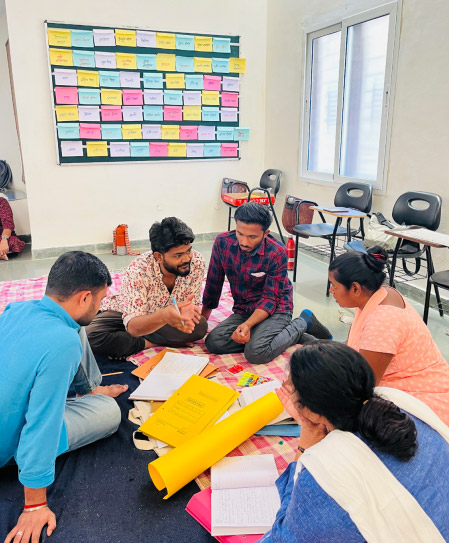
On the face of it, it is a really simple exercise. Team leaders from a three-decade-old rural development organisation are seated on woven floormats, organised in four groups – a team working on education, a team working on health, another on livelihoods and the last on agriculture. Most of them are between 25 and 40 years old. Some are older with several years of field experience. The majority are from nearby rural communities. It is a mixed group of men and women, including self-help group (SHG) leaders, community leaders and office team members.
Each group is given copies of the ‘Constitution of India’, with the following set of instructions –
‘Link your work with one or more provisions in this book, especially Part 3 – Fundamental Rights (Right to Equality, Right to Freedom and Right against Exploitation), Part 4 – Directive Principles of State Policy and Fundamental Duties and Part 9 – the Panchayats. Read. Discuss. Take your time.’
Complete silence.
Then, a few quizzical glances. A bit of head scratching. Some roll up their kurta sleeves. Huddles of twos and threes, with others listening in but not quite speaking yet. Hushed discussions. A couple of people take the book and flip onto their stomachs, reading intently. Others take notes. More huddles, a bit tighter this time. The volume rises. Animated gestures follow. Questions back and forth.
‘But agriculture is not even mentioned in the Fundamental Rights. How did this happen?’
‘Arey, but Article 21 mentions Right to Life. No agriculture, no food, no life. So obviously that’s the link.’
‘Here is Article 21A, the right to education. So, this is how it’s mentioned in the Constitution, under the right to life. It is shown as 21A after the amendment in 2002.’
‘And look here, the Schedule 11 that mentions the responsibilities of the Panchayats. Oh, the Panchayat is responsible for almost everything that we work on – education, health. Such a long list, it has 29 items!’
Ah. Ha. Ha. There are only 35 people in the room, but it is as if a million bulbs have lit up.
The next step in the exercise is to use Google to find the laws and government orders that connect to their work.
Minutes ticked by. Tea cups passed around. Loud slurps. Louder voices. Connections slowly being made between what happens on the ground, in their work areas, with the communities they work with, and the provisions made in the law.
‘Section 19 of the RTE Act mentions two teachers for sixty children. But we have only one in the primary school in the village. We have tried so hard, but the officials say they are unable to find anyone. But this is a guarantee by law, so it should happen.’
Section 5 of the Jharkhand Panchyati Raj Act states that the Gram Sabha shall meet from time to time, but not more than three months shall intervene between any two meetings. This means that there should be a minimum of four meetings in a year! But that does not happen.’
Now, the final step of the exercise. Write down one or two problems that the community is facing right now. Give details of the problems and explain them by referencing the constitutional and legal provisions. Suggest solutions and state what you want done.
Penny drop. Pin-drop silence. Again.
Until the groups get into action. Bent over, working furiously, the Constitution and its language of power buzzing through their minds, and emerging in shades of blue and black on a single sheet of white paper.
This is a scene from one Training of Trainers program in Jharkhand. But it is happening in different parts of the country with leaders from social sector organisations working on a whole host of very pressing issues – disabilities, discrimination, violence, poverty, mental health.
What is happening here is not rocket science. It is not an esoteric puzzle solved by a few. It is an essential, practical capability for all leaders in the social sector, on how to understand and use the Indian Constitution in their work.
What does it do?
It firmly establishes the connection between the work done on the ground (getting children to school, forming SHGs for financial inclusion, etc.) and its moral underpinnings: the values of equality, dignity, justice and freedom, stated clearly in our Constitution.
For leaders in the social sector, this connection is powerful. It strengthens not only motivation but also clarity of purpose and legitimacy of action.
The values of the Constitution also provide a lens to evaluate how leaders lead, how we make decisions: in the community, with our teams and staff. Do we put these values into practice? Do we lead with dignity? Do we listen to all voices? Do we create spaces that are inclusive?
The values of the Constitution also provide a lens to evaluate how leaders lead, how we make decisions: in the community, with our teams and staff. Do we put these values into practice? Do we lead with dignity? Do we listen to all voices? Do we create spaces that are inclusive?
‘Something clicked for me now. When we organise community meetings, we sometimes just do it in the village temple. And I noticed that some women would sit just outside on the steps. It struck me as odd, but I did not think of it much. Now, I realise that the place may not be inclusive for all. And perhaps I should have been more mindful and consulted everyone on what place was fine for all’, reflected one of the SHG leaders.
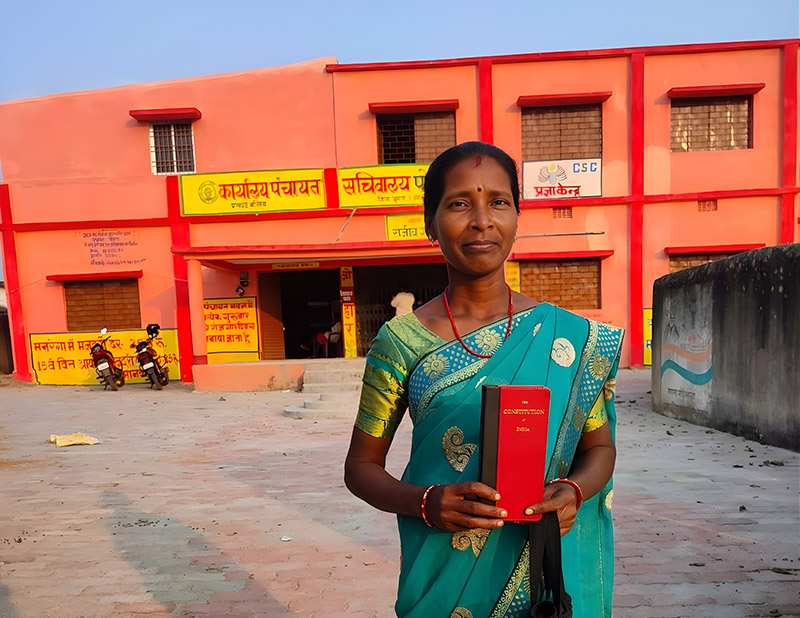
It also provides exposure to all that the government does to meet its mandate – all the schemes, services and systems it has put into place. It is true that not all of it works, and that sometimes it is difficult to work with government systems. But they exist as a constitutional mandate. They must be engaged with, take advantage of and enabled to serve the people they are meant to serve.
This is why leaders must actively engage with the government ecosystem.
Perhaps the most important shift that constitutional literacy enables is this: it changes how we see the people we work with, from beneficiaries to citizens.
They are not people who receive something as a benefaction. People are truly rightful holders. Every single government service is a right, and therefore our role as leaders is to facilitate those rights and to build people’s understanding of themselves as citizens.
When leaders use the term beneficiaries, they can unintentionally reduce people’s power and agency, and in doing so, reduce their own role as nation builders. Seen through the framework of the Constitution, we are all working towards one goal: a just, free and equal society.
And as leaders in India’s social sector, we are not just service providers. We are contributors to the living promise of the Constitution.
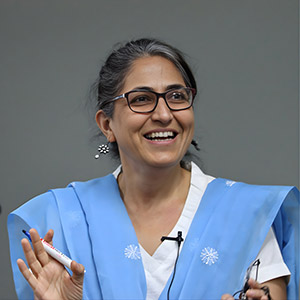
Vinita Gursahani Singh
Managing Trustee, We The People Abhiyan
Vinita Gursahani Singh is the founder of We, The People Abhiyan, a nonprofit promoting active citizenship in India. She has empowered marginalised communities to engage with governance systems and drive change using the constitutional and legal framework. She has led projects with the Delhi Education Department and the National Council for Vocational Education and Training to embed active citizenship in education. A compelling public speaker, she has addressed audiences at TEDx events, educational forums, and on the radio, advocating for strengthening citizen participation in evolving democracies like our own.
Copyright © 2026 India Leaders For Social Sector