
Cover Story
Sewa Bhaav: Reimagining Leadership for the Social Sector
Piramal Foundation (Written by Tripti Vyas and Lakshika Pant)
Across India’s social sector, leaders are working on systemic problems of unprecedented complexity. Whether it is improving foundational learning outcomes, strengthening public health delivery, or enabling last-mile access to public systems, these are not challenges that yield easily to linear solutions. They are systemic, adaptive and at their core, they are deeply human. Yet, when we examine how leadership teams are developed, the emphasis continues to be on strategy and scale. We invest in building programmatic capability, strengthening operational excellence, and designing replicable interventions. While these are necessary, increasingly they are not sufficient.
Public systems do not transform through programmatic interventions alone. They transform through the quality of human interactions within them. The quality of these interactions is shaped substantially by the inner landscapes of the people leading and working within them.
At Piramal Foundation, this is why we place personal transformation at the very centre of who we are and what we do.

Personal Transformation as the Driver for Public Systems Transformation
When confronting the social sector’s complex, non‑linear challenges, the instinctive response is often technical: design better programs, sharpen strategies, and invest in stronger data, tools, and frameworks. When systems still fail to change, we assume the program model needs refinement. But what if transformation demands something much deeper than that?
Consider public health institutions that serve at the heart of our nation, where other health services cannot reach. Piramal Foundation’s core belief is that the public health system is made up of people who have the will and desire to serve their communities. Our efforts are directed to unlocking their agency to serve, to improve themselves, to be effective at their work, to grow by merit and to influence the system around them.
Within this system are Referral Care Units serving lakhs of people each, where access to Caesarean sections is critical for managing complicated pregnancies with direct consequences for maternal and infant mortality. Despite the importance of C-sections, we found many facilities unable to offer these even when trained medical personnel and adequate infrastructural and medical resources were present. The constraint was not technical capacity, but the human dynamics within the system. Enabling the first C-section in each unit required strengthening internal collaboration, building a shared understanding of why the service mattered, and restoring a sense of meaning and responsibility among leaders. Unlocking the ‘agency to serve’ across their roles emerged as the most powerful lever for unlocking what the system could deliver. When we reinforced personal, social, people, and overall leadership skills, the system transformed as the people within it transformed.
We worked with 16 such facilities and 633 public health officials to make 9 First Referral Units (FRUs) functional at the sub-district level across Bihar. These FRUs are estimated to serve a population of 3 million people.
The idea isn’t to solve the problem for public system leaders. We seek to develop frameworks and programs rooted in empathy and compassion that help them connect with each other and work together to solve problems and implement change in their domain.
Aditya Natraj, CEO, Piramal Foundation; Founder, Kaivalya Education Foundation
At scale, systems transformation is not only the result of better interventions, but of better interactions among human beings within the system.
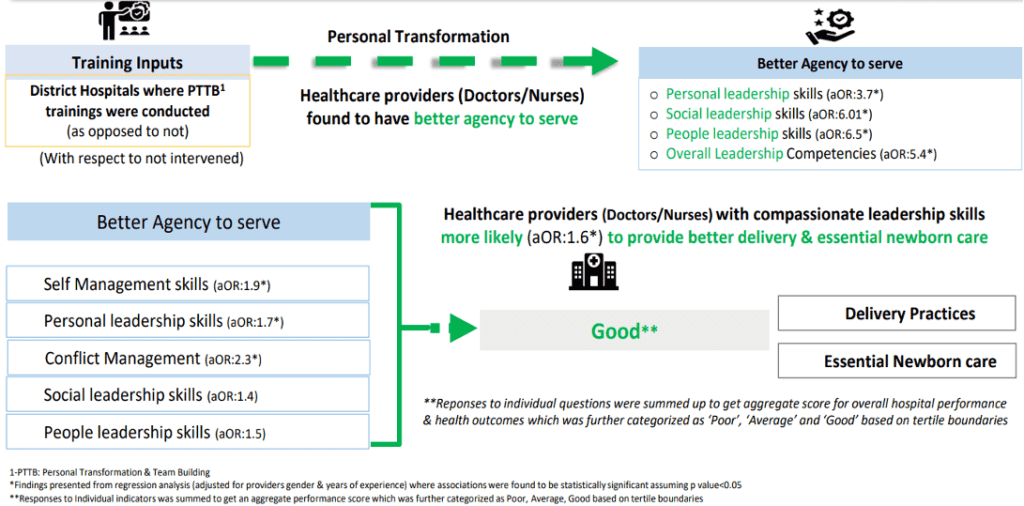
At Piramal Foundation, we choose to start here. Our Theory of Change has been anchored in this simple premise: systems transform only when the individuals within them do.
This is not a philosophical position. It is a practical one.
The public systems we work in, across domains, are human systems. Leadership in such systems is defined by how leaders show up when things are uncertain or inconvenient. When leaders operate from authority, systems respond with compliance. When leaders operate from fear, systems respond with disengagement. Both can look like progress in the short term. Neither sustains change. Until leaders change how they relate to themselves, to others, and to the system, no amount of external design will produce internal alignment.
When leaders operate from self-awareness and act with a genuine orientation toward service, conversations become real, disagreement becomes possible, and there is room for ownership to emerge.
This is why we place personal transformation as the primary lever of systems transformation.
Defining What Personal Transformation Means for Piramal Foundation
While personal transformation is a key lever for our public systems transformation, it is also a fundamental building block of what we practice within Piramal Foundation.
In many models, leadership development is understood as the acquisition of skills. While valuable, this framing underestimates the depth of personal change required by leaders.
We frame personal transformation as a structural shift in how a leader experiences themselves and the world. It is not about becoming better at doing. It is about becoming different in being- a greater alignment between how we think, feel, and act.
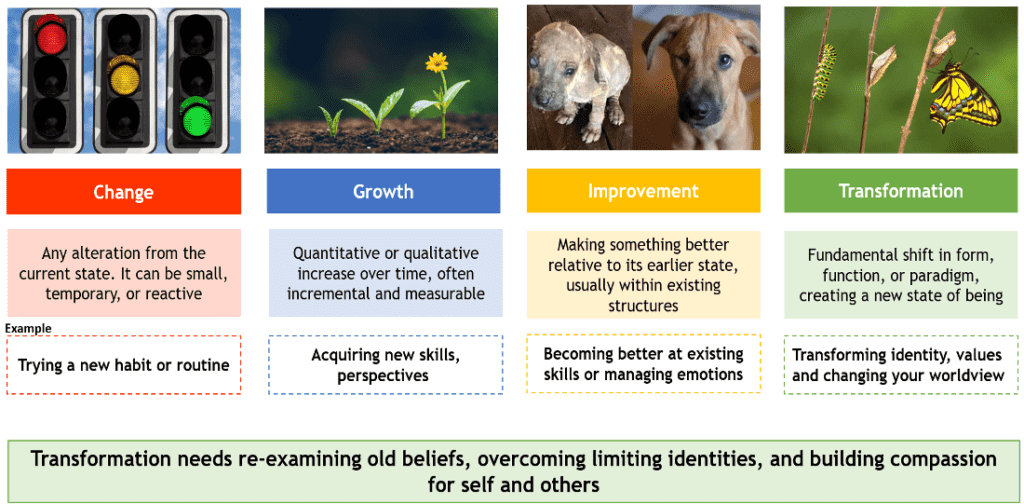
Compassionate Leadership is not a mere philosophy, it is action rooted in humility, resilience in the face of difficulties, clarity of purpose and the courage to serve anonymously.
Ajay Piramal, Chairman, Piramal Group
- How We Relate to Others: Transformation begins when individuals move from reacting to relating to others, listen without defensiveness, express needs without blame, and influence through trust rather than authority.
- How We Relate to Ourselves: Most of us operate based on internal patterns shaped by fear, perfectionism, or the need for approval that strongly influence our behaviour. Becoming aware of these patterns, we begin to engage with authenticity, vulnerability, and emotional clarity.
- How We Tune-In to Our Bodies: Increasingly, research shows that stress and unresolved experiences are not just cognitive; they are physiological. Learning to regulate our physical responses to situations contributes to sustained behavioural change.
- What Gives Us Meaning: As individuals develop awareness and stability, they begin to orient toward purpose, moving from self-focused goals to a deeper sense of contribution and responsibility.
When these dimensions align, the choices leaders make are no longer something leaders ‘do’, they come closer to representing who they are.
From Personal Transformation to Sewa Bhaav
At Piramal Foundation, Sewa Bhaav is a key driving force for personal and systems transformation. In the context of a leader, it is seen as ‘Serving Those Who Serve the Community’.
Sewa Bhaav brings together Sewa (acts of selfless service) and Bhaav (inner motivation and ethical intent behind action).
Social sector organisations need to deliver previously unimagined outcomes in increasingly complex social and public systems. They need to spark purpose in teams that are perpetually overextended and working in uncharted territory. They need to inspire trust amongst partners, stakeholders, and communities who have little reason to extend it. In these contexts, leadership based on authority may lead to transactional relationships, treating this like a job. This does not ultimately serve the community or public systems.
At Piramal Foundation, leaders do not direct, control, or decide; they simply enable others to succeed. They remove barriers and create conditions where people and systems can function at their best. This expands on Robert Greenleaf’s idea of the ‘servant leader’, where leadership begins with service, prioritising the growth, well‑being, and capability of others.
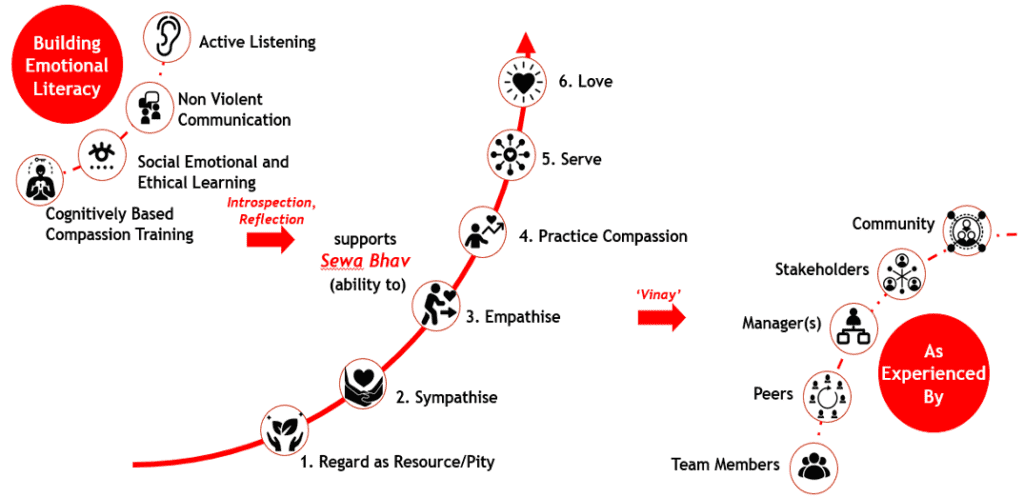
This shift in leadership has profound implications. Sewa Bhaav is not something a leader claims to have. It is something others experience. The real test of this lies in action, particularly in what leaders do in moments of pressure. We refer to these as ‘Moments of Truth’. These can be situations like navigating conflict, responding to failure or navigating ambiguity.
In moments of ambiguity, a leader with Sewa Bhaav engages others in co-creation, rather than withdrawing or imposing direction prematurely. In moments of failure, Sewa Bhaav leads to collective problem-solving, without assigning blame or distancing oneself.
These moments may appear small, but over time they determine whether relationships become transactional or transformative.
Embedding Sewa Bhaav and Personal Transformation into Piramal Foundation
As they become embedded in our systems and processes, personal transformation and Sewa Bhaav impact not just individuals but also the organisations or systems they are part of.
At Piramal Foundation, this is ensured through deliberate design.
- Who Joins Us: Across levels, who joins Piramal Foundation is determined after deeply understanding what drives them and gives them meaning. We look for leaders who are not only great at what they do but also have a great affinity for personal transformation and Sewa Bhaav.
- Who They Work With: A community of peers with a shared affinity for personal transformation is crucial. At Piramal Foundation, we call this our Sangha; each leader has a community of people from their current work context who are on a similar journey for their own evolution or transformation.
- What Gets Measured: Our performance management system is designed to capture the lived experiences of Sewa Bhaav, created for key stakeholders and not just reported performance in terms of impact metrics. Outcomes matter, but so do the behaviours through which those outcomes are achieved.
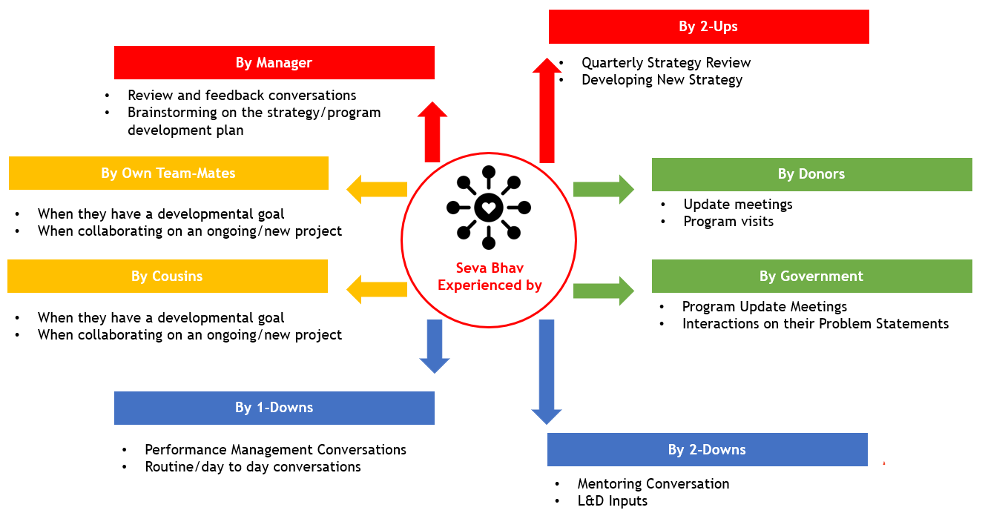
- What Gets Encouraged: Promotions are linked not only to results (What), but to the leaders’ embodiment of Sewa Bhaav (How) in everyday interactions and the commitment to nation building (Why) that leaders demonstrate.
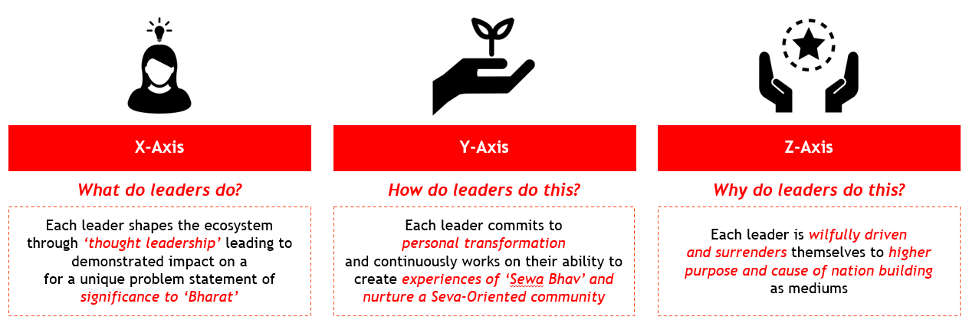
From Leaders to Systems: How Sewa Bhaav and Personal Transformation Scale
A pattern emerges consistently in leaders who have had sustainable and impactful careers within Piramal Foundation. They describe how recognising and transforming a limiting mindset or internal narrative has deepened both their own sense of purpose and the impact they unlock for public systems.
Sangeeta Mamgain relates how she came into this organisation nine years ago with a strong drive to make an impact. She had to spend time to understand the pain of people within public systems, learn to acknowledge their experience and develop empathy towards them. This needed her to first engage with her own sense of purpose. As she discovered that what mattered to her was seeing change in the systems around her, and not who the success was attributed to, she moved from ‘I know how to do this’ to embracing her role as an integrator of people, ideas and approaches. She attributes her ability to untangle complex problems, co-create solutions, and drive ownership in teams and with stakeholders to this shift in mindset.
Kartik Varma recalls how he joined nine years ago because he wanted to work on transforming the education system. His first realisation was that the capabilities he had built in 2 decades of consulting were not sufficient for what he needed to do here.
He realised that a key aspect of this journey is not what he does but who he is. He examined his relationship with himself and others with compassion and kindness, and in this process of discovery, his sense of meaning has shifted from ‘solving problems’ to dedicating his life to the service of others.
Reflecting on his journey of 14 years from a 21-year-old Gandhi Fellow to a core team member at Piramal Foundation, Vaibhav Pandey describes the key shift in himself from apathy, dissatisfaction and finding intellectual solutions to someone who has become deeply reflective over the years. His experience is that by reflecting on his own behaviours and demonstrating he can change, the teams he leads and public system actors he works with have deeper conviction in their ability to transform as well.
Examples abound of inner shifts in perspectives that have helped our leaders become more valuable to the people and systems around them. When individuals transform, their interactions with others change, trust builds and enables collaboration, allowing complex systems to move. Systems change when relationships change at scale.
Examples abound of inner shifts in perspectives that have helped our leaders become more valuable to the people and systems around them. When individuals transform, their interactions with others change, trust builds and enables collaboration, allowing complex systems to move. Systems change when relationships change at scale.
In our experience, leaders who embody this shift begin to move beyond managing programs to building institutions. They invest more in alignment than in control. They engage more deeply with stakeholders. They hold complexity without rushing to closure. Systems that were previously fragmented begin to align. Stakeholders who were passive become active contributors. Solutions that were externally driven begin to be internally owned.
If the inner ecosystem of leaders shapes the condition of our outer ecosystem, then the implications for the social sector are significant.
Foremost, what is considered leadership development must expand beyond competencies. It must include structured engagement with self-awareness, emotional capability, and reflection. Institutions must take responsibility for creating the conditions that enable personal transformation. This includes psychological safety, reflective spaces, and alignment between espoused values and lived systems.
India’s development challenges will require leaders who can navigate complexity without oversimplifying it, who can build trust in low-trust environments, and who can remain anchored in purpose amidst constant change.
India’s development challenges will require leaders who can navigate complexity without oversimplifying it, who can build trust in low-trust environments, and who can remain anchored in purpose amidst constant change.
Sewa Bhaav offers a way of understanding and cultivating such leadership. It integrates modern insights from psychology and neuroscience with a deeply rooted philosophical orientation toward service. It does not separate effectiveness from ethics, or performance from purpose. Instead, it brings them together.

Ultimately, the future of leadership in the social sector will not be defined by how efficiently we manage systems, but by how deeply we are willing to transform ourselves to serve them. Because when leaders shift from asking, ‘How do I achieve outcomes?’ to asking, ‘Whose suffering am I here to reduce?’ something fundamental changes.
That is where systems begin to transform.

About Piramal Foundation
Founded in 2011, we are dedicated to addressing critical barriers to India’s development through innovative, scalable solutions.
Piramal Foundation brings over 18 years of proven expertise in public system transformation, touching 143 million lives across education, health, gender, and water. Guided by Sewa Bhaav, a spirit of service rooted in the belief that personal transformation drives systems change, the Foundation enables government to strengthen public service systems by building capabilities in service-led leadership, digitisation, decentralisation, and inclusion.
Piramal Foundation’s work is guided by a core principle: values shape action, and action drives change. Under the guidance of Chairman Ajay Piramal, the Foundation upholds Sewa Bhaav (selfless service), humility, and trusteeship as its guiding values. Sewa Bhaav embodies the Foundation’s commitment to selflessly serving society and finding fulfilment in service. Humility fosters a collaborative spirit by recognising that no individual or institution has all the answers, paving the way for partnerships that amplify impact. Trusteeship emphasises the belief that resources belong to the community, promoting transparency and responsible management for collective benefit.
These core values are not merely abstract principles; the Piramal Foundation continues to apply these values to its present-day initiatives across domains.
Copyright © 2026 India Leaders For Social Sector