
SPO Financials
Reading the Vital Signs
Kavita Gunderia and Urmila Sampath - Partners, LTM Advisors LLP

In Brief
- Read beyond the numbers: Cash and deposits do not necessarily indicate financial strength when funds are restricted or reserves are limited.
- Assess financial flexibility: Look at unrestricted income, reserves, committed grants and corpus to understand the organisation’s ability to meet its obligations.
- Watch cash flow: Even well-funded SPOs can face cash-flow stress when grant disbursements are delayed.
- Ask for the right information: Boards need regular financial reporting that connects expenditure, funding and programme plans, and highlights potential risks.
A trustee or director on the governing board of a nonprofit or social purpose organisation (SPO) holds fiduciary responsibility to secure and manage the financial assets of the organisation, unlike an advisory board member who may lend their expertise to the SPO only in specific areas. Taking on a board position therefore requires a good understanding of the financial position and performance of the SPO.
Several board members come with vast experience in the commercial or corporate sector and are accustomed to reading and understanding corporate financial statements. However, there are certain nuances or differences with respect to SPO financial statements, which are relevant for assessing its financial health and performance. This article highlights some of these as a starting point for building that understanding.
Why does an SPO prepare financial statements?
Just as companies in India are required to prepare financial statements in accordance with applicable accounting standards under the Companies Act, 2013, SPOs are required to prepare financial statements for statutory purposes based on their legal form.
However, SPOs that are registered as public charitable trusts are required to annually file their balance sheet, income and expenditure account and statement of income chargeable to contribution in prescribed formats. The audit report must comment on specific questions listed in the respective public trust rules related to maintenance of books of accounts.
How can we assess an SPO’s financial strength?
We address this question with the help of the following simple example:
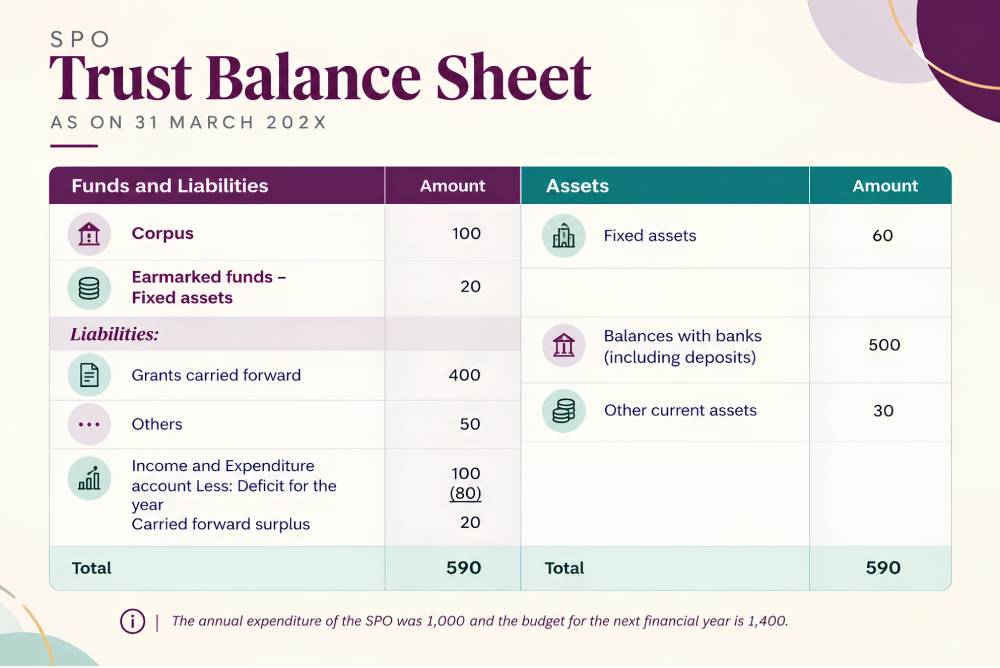
Given the significant funds in deposits, it appears that the SPO is well funded. However, the following aspects may paint a different picture:
- A substantial portion of the funds relates to restricted grants received in advance (which are presented as a liability).
- Further, there was a deficit of (80) in the year that has eroded reserves to a significant extent, and available funds from unutilised grants were not used to cover this deficit, likely due to grant restrictions. This indicates that the SPO’s funding sources are primarily restricted in nature and may not cover certain expenses.
- There is a relatively small corpus, which is insufficient to generate enough interest income to cover the deficit.
Collectively, these indicate that the SPO may be financially vulnerable due to insufficient operational reserves and mismatched funding.
What are some financial metrics to consider?
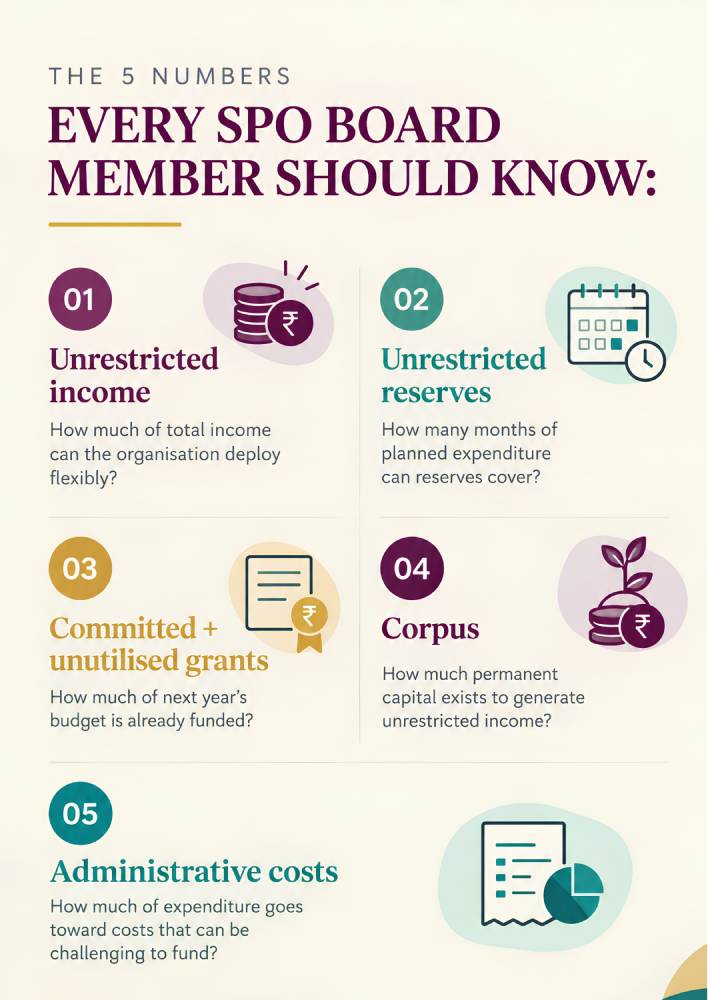
- Proportion of unrestricted donations/grants to total income – indicating how the organisation is able to cover expenses that are not specifically funded through grants, such as administrative costs.
- Unrestricted reserves – in terms of the number of months of planned expenditure covered, as an indicator of flexible funds available to meet expenses until funding is fully raised for the year.
- Committed grants and unutilised (carried forward) grants as a proportion of the planned annual budget for the following year, as an indicator of funding secured for the year.

- Corpus of the organisation (which is akin to permanent capital that cannot be used for operating expenses) which can generate unrestricted funds in the form of interest income.
- Administrative costs as a percentage of total annual expenditure – most CSR grants restrict the proportion of funding for such costs to 10% or less. Further, foreign funding carries a statutory restriction of 20% of funds to be spent on administrative costs. Therefore, a high percentage of administrative costs is challenging to fund.
What other financial information would I need as a new SPO Board member?
Just as a corporate entity prepares management information (MIS) to support oversight and decisionmaking, SPOs need to provide periodic financial information to their boards and senior management.
Just as a corporate entity prepares management information (MIS) to support oversight and decision-making, SPOs need to provide periodic financial information to their boards and senior management. Some critical information to include is:
- A status of actual expenditure by nature/function against budgets to assess if the expenditure incurred is in alignment with planned program progress.
- Analysis of actual expenditure against funding raised for each category of expenses. This can help identify potential over- or under-utilisation of funds. Unlike in a corporate setting, deviations from budgeted expenditure have broader implications in an SPO, since a large proportion of the budget is financed through restricted grants. These are required to be fully utilised within the specified budget categories by the end of the grant period (CSR grants are to be fully utilised by the end of the financial year). Reallocating funds is challenging and often requires approval from the donor’s board.
- A cash flow that shows the status of available funds and expected inflows segregated by source (domestic/foreign, unrestricted/restricted, etc) against the estimated expenditure for the quarter/year. While an SPO may be fully funded through committed grants, disbursal of funds may lag by a few months, leading to cash flow stress on the organisation. Regulations also do not permit mingling of domestic and foreign funds, necessitating a segregated cash flow analysis.
While SPO financial statements are relatively simpler in terms of disclosures, the regulatory and funding nuances discussed above are critical to their interpretation and for decision-making.

Kavita Gunderia and Urmila Sampath, both chartered accountants, are the Co-founders of LTM Advisors, which specialises in strengthening financial management, reporting, and governance frameworks in nonprofits.
Copyright © 2026 India Leaders For Social Sector