January 2026 – Edition 05

Guest Column
Doing More with Less: Digital Transformation of Nonprofits in India
Sanjeev Prasad
Advisory Board Member, Anudip Foundation; Ex-Global Business Head, Cloud & Digital, Coforge
Why Digital Transformation Matters for Nonprofits…and Now
Indian nonprofits today face a difficult paradox. Expectations around scale, accountability, and measurable outcomes are rising, while funding, talent, and organisational bandwidth remain constrained. Philanthropists increasingly expect data-backed impact narratives, regulators expect audit readiness, and communities expect programs to expand without compromising quality.
In this context, digital transformation has become essential — not as a trend, but as an operational necessity. Global and Indian research consistently points to digital as a key enabler for efficiency, transparency, and scale in the social sector [1][2]. Yet, transformation is not about adopting technology for its own sake. It is about strengthening mission delivery.
Having spent four decades leading large-scale transformation journeys in the corporate sector and mentoring social purpose organisations (SPOs) through real-world digital change, I have learned one thing clearly: when digital is anchored to purpose, it becomes a force multiplier. When it is treated as a standalone initiative, it often becomes an expensive distraction.
Reframing Digital Transformation: Start with the Problem, Not the Tool
A core principle I emphasise repeatedly is simple: nobody should do technology for the sake of technology. Digital transformation must start with clarity on the problem to be solved, whether operational inefficiency, fragmented data, or limitations in program reach.
Many SPOs fall into the trap of digitising broken processes. Manual reporting is automated without removing duplication; siloed systems are introduced because a donor requires them; pilots remain fragmented and never scale. Research from global nonprofit studies highlights this pattern clearly. Technology alone does not create impact unless organisational fundamentals are addressed first [2][5].
This is where process discipline becomes critical. Lean thinking — long used in manufacturing and services — offers powerful lessons for SPOs. By identifying delays, rework, and non-value-adding effort, organisations can simplify workflows before digitisation. Digital then amplifies what already works, instead of locking inefficiencies into systems
Many SPOs fall into the trap of digitising broken processes. Manual reporting is automated without removing duplication; siloed systems are introduced because a donor requires them; pilots remain fragmented and never scale.

The Five Pillars of Effective Digital Adoption in SPOs
- Process: Simplify Before You Digitise:
Effective digital journeys begin with mapping value streams from beneficiary to donor. Manual reporting, duplicate approvals, and fragmented data flows consume enormous staff time across SPOs globally [1]. Small, focused improvements, such as standardising data capture or integrating reporting, compound into significant efficiency gains over time. - People: Mindset, Capability, and Change Management:
Digital transformation is fundamentally a people’s journey. Tools do not change organisations, and people do. Building comfort with data, fostering experimentation, and investing in training across leadership and field teams are essential. Studies show that SPOs that invest in change management and internal capability are far more likely to sustain digital gains [5]. Leadership sponsorship and cross-functional ownership are non-negotiable. - Technology: Fit-for-Purpose, Not Cutting-Edge
SPOs do not need the latest technology; they need the right technology. Modular, scalable, and affordable tools, often cloud and mobile-based, deliver the highest return. Increasingly, AI is helping SPOs bridge human capacity gaps, from learning support to administrative functions, without inflating costs [4]. Build-versus-buy decisions must be grounded in organisational readiness, not aspiration.

- Focus on Data
One of the crucial steps in digital transformation is having the right data framework and architecture. Especially in today’s AI-led world, data is key to defining relevant program interventions for targeted population segments, optimising fundraising strategies, scaling impact, and strengthening governance. Creating the right data architecture / framework is key to creating solutions which are sustainable and impactful for beneficiaries.
- Governance and Sustainability
Digital systems must be treated as long-term organisational assets. This requires embedding digital costs into program economics, ensuring data privacy and security, and remaining audit-ready. Research from global development institutions underscores that sustainability, not pilots, is what separates successful transformations from failed ones.
From Theory to Practice: Lessons from the Field
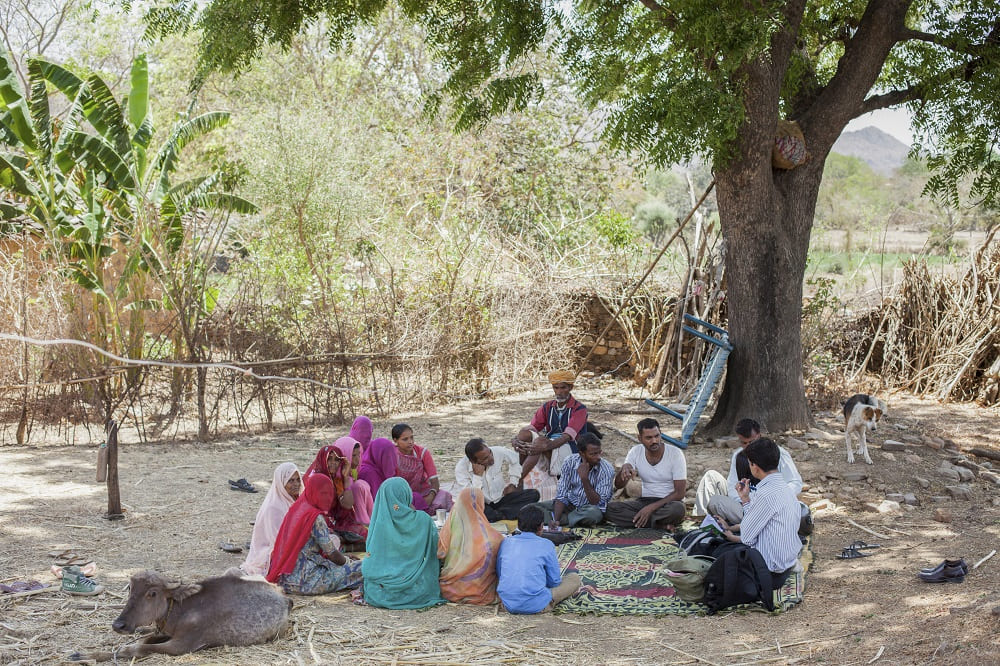
A. Seva Mandir: Strengthening Community-Centric Programs Through Integrated Data
Seva Mandir operates at a significant scale across multiple development themes and geographies, with deep roots in community engagement. When I began working with their team, a disproportionate amount of staff time was consumed by manual data aggregation and reporting across programs.
By shifting to integrated family- and village-level databases and a digital MIS, reporting became faster, more accurate, and decision-ready. Program teams reclaimed time for meaningful community engagement, while leadership gained real-time visibility into impact trends. Crucially, the systems succeeded because they respected Seva Mandir’s long-standing, people-first approach rather than imposing a purely technical solution. Equally important was the significant focus directed towards process mapping, designing solution components and how they will be stitched into a meaningful data architecture, before starting to build the applications.
Anudip Foundation: Using Technology to Multiply Program Reach and Quality
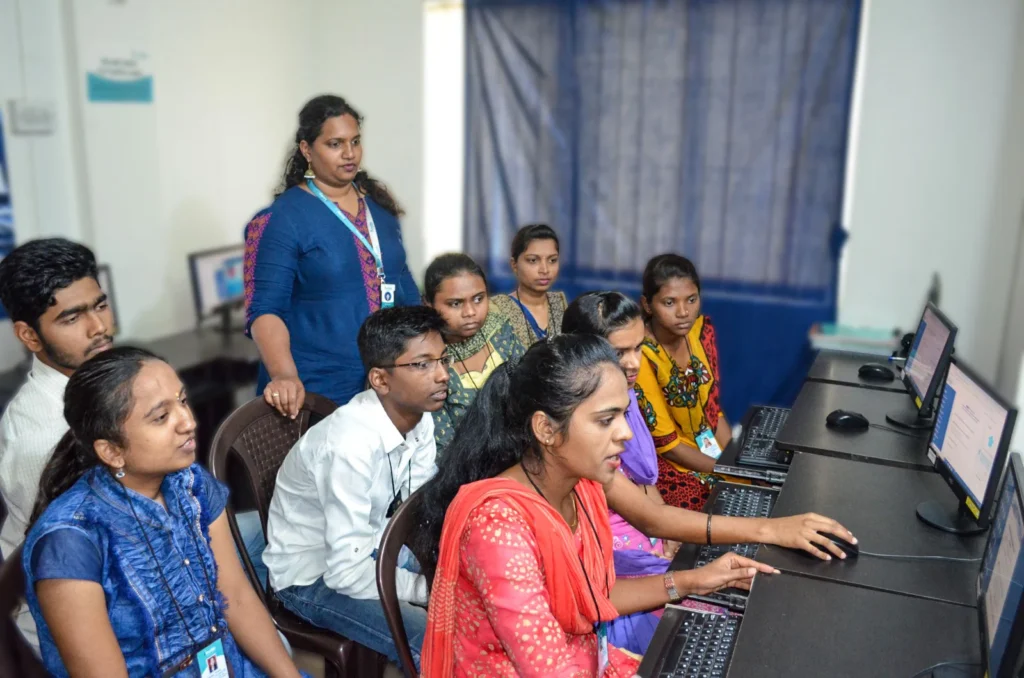
Anudip Foundation operates nationally, training large numbers of learners for employment. Here, the challenge was human capacity at scale. Through carefully designed digital and AI-enabled tools, Anudip augmented trainer capacity, enabled personalised learning for thousands of learners, and dramatically accelerated content creation.
What impressed me most was the discipline around change management, budgeting, and iteration. Technology was used to augment human effort, not replace it, allowing Anudip to scale without compromising program quality.
Digital as a Force Multiplier for Social Impact
Digital transformation is not a destination; it is a continuous journey. SPOs should start small, learn fast, and build confidence through early wins. The temptation to chase tools must be resisted; mission outcomes must remain the anchor.
With patient capital, long-term thinking, and disciplined execution, digital can free SPOs to focus on what matters most: beneficiaries and communities. Done right, digital truly enables us to do more, with less.
Sources
- Stanford Social Innovation Review – Creating a Digital-First Strategy
https://ssir.org/articles/entry/creating_a_digital_first_strategy - Nonprofit Quarterly – Digital Transformation: A Nonprofit Primer
https://nonprofitquarterly.org/digital-transformation-a-nonprofit-primer/ - AIJMR – Digital Transformation in Nonprofit Organisations
https://www.aijmr.com/research-paper.php?id=1097 - Salesforce – Nonprofit Technology Trends
https://www.salesforce.com/news/stories/nonprofit-statistics-trends-2022/ - Reworked – Digital Transformation Is Leaving Some NGOs Behind
https://www.reworked.co/digital-workplace/digital-transformation-is-leaving-some-ngos-behind/

Sanjeev Prasad
Advisory Board Member, Anudip Foundation; Ex-Global Business Head, Cloud & Digital, Coforge
Sanjeev has been a serial entrepreneur, business leader, and CIO for large global corporations. He has been part of the global leadership team at Coforge, Genpact, and Sutherland and a founder, COO, and director of STG International Ltd. His initial years were spent developing and managing new products in leading companies like Nortel, Amdahl, and a healthcare startup in Silicon Valley acquired by General Electric.
Sanjeev is focused on enabling business transformation and identifying and creating successful new ventures at key technology inflexion points — client-server to internet age, cloud, and now digital transformation enabled by cloud, AI, mobile, and social technologies.
He has been on the advisory boards of Oracle, Gartner, and Avaya. He is a certified coach, investor, adviser, and mentor to various startups.
Copyright © 2026 India Leaders For Social Sector